Recently I was made aware by a neighbor that the ward is considering tearing down a few trees in order to add parking spots to Eastlake Terrace. The proposal would take down five trees while adding 6 spots. Below is the letter that I wrote to our Alderperson in addition to responding to the survey asking for feedback on the proposal.
Dear Maria Hadden,
I recently learned about the proposal to remove trees along Eastlake Terrace to add parking spots to alleviate limited parking. I have some concerns regarding this proposal and would like to share my thoughts with you. They run along the lines of traffic pattern concerns, reworking existing spaces, parking behavior, and the impact on the surrounding environment. It is not my intention to be a NIMBY but I think I have insight into important information that should affect the proposal.
Traffic Concerns
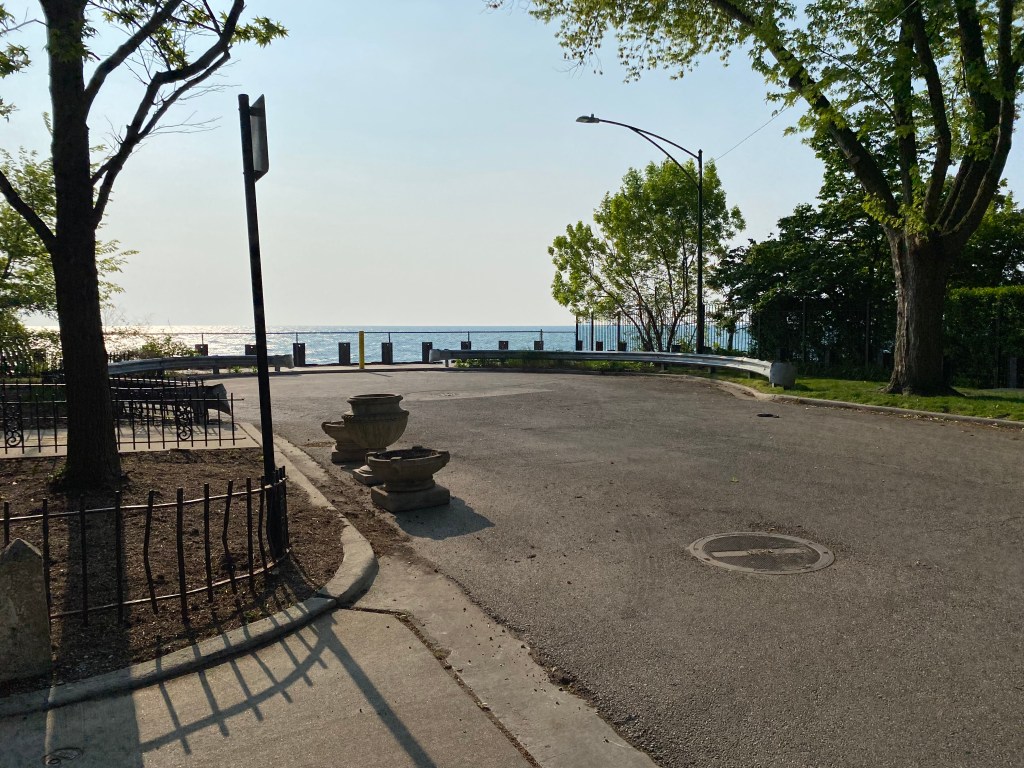
I have a unique perspective on this situation as I live at the intersection of Birchwood and Eastlake Terrace. My desk looks over the street and I have a great vantage point to see the flow of my neighborhood. One of the things I see quite often is near-miss accidents. Why is that? Eastlake Terrace is a one-way street that dead ends onto a two-way street that dead ends at the lake. There isn’t clear signage showing that there is a turnaround at the end of Birchwood, so many people partially pull into the parking lot to the west of me and then reverse into Eastlake Terrace at an angle which has a lot of blind spots about those southbound on Eastlake Terrace. I’m concerned that adding that many spots right there will increase accidents. If nothing else comes from this email, please add signage indicating the turnaround.
Reworking Existing Spaces
Improving the turnaround at the end of Birchwood is one of the solutions I suggest. The turnaround is incredibly tight, even for smaller cars, and drivers need to make multipoint turns to get out of it. It’s basically unusable for the mid-sized Pace van that picks up a neighbor daily. That is further exacerbated by a neighbor who has permanently moved cement planters into the street. They have moved them into a space that says no parking but could be ideal for a compact car if the turn wasn’t so tight. Right now parking there would most likely result in being hit by drivers who misjudged how tight the turn is. I believe that the area where the turnaround and the street connect could be “shaved” to improve its use of it and allow that small space to be utilized by smaller cars or motorcycles.
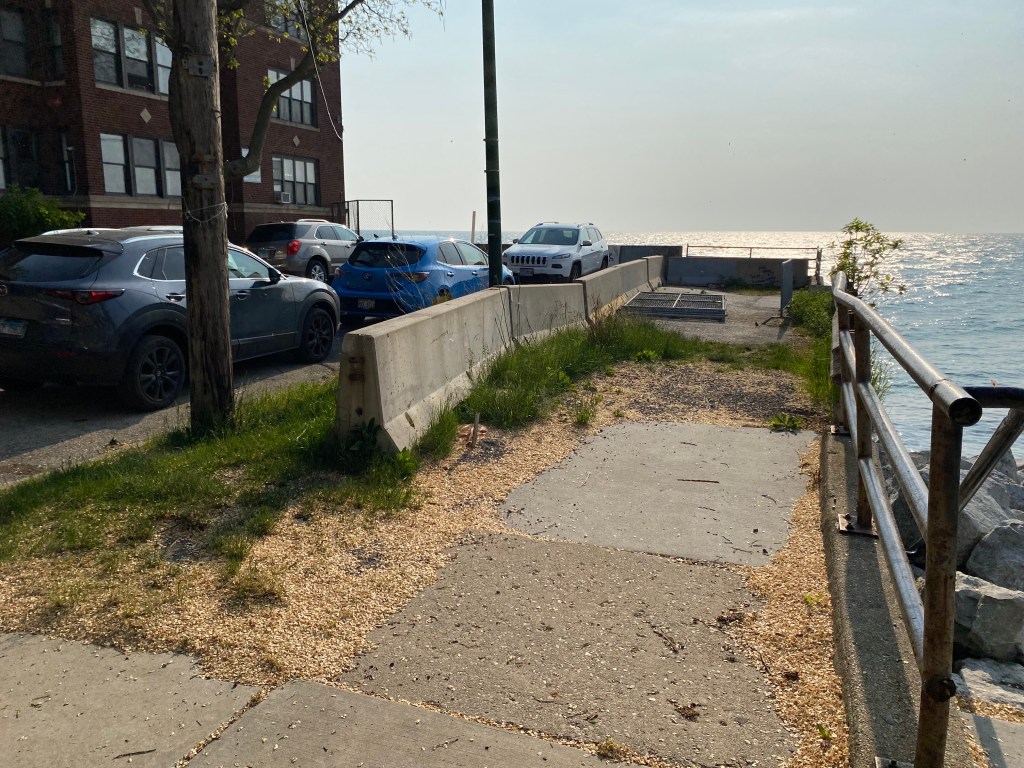
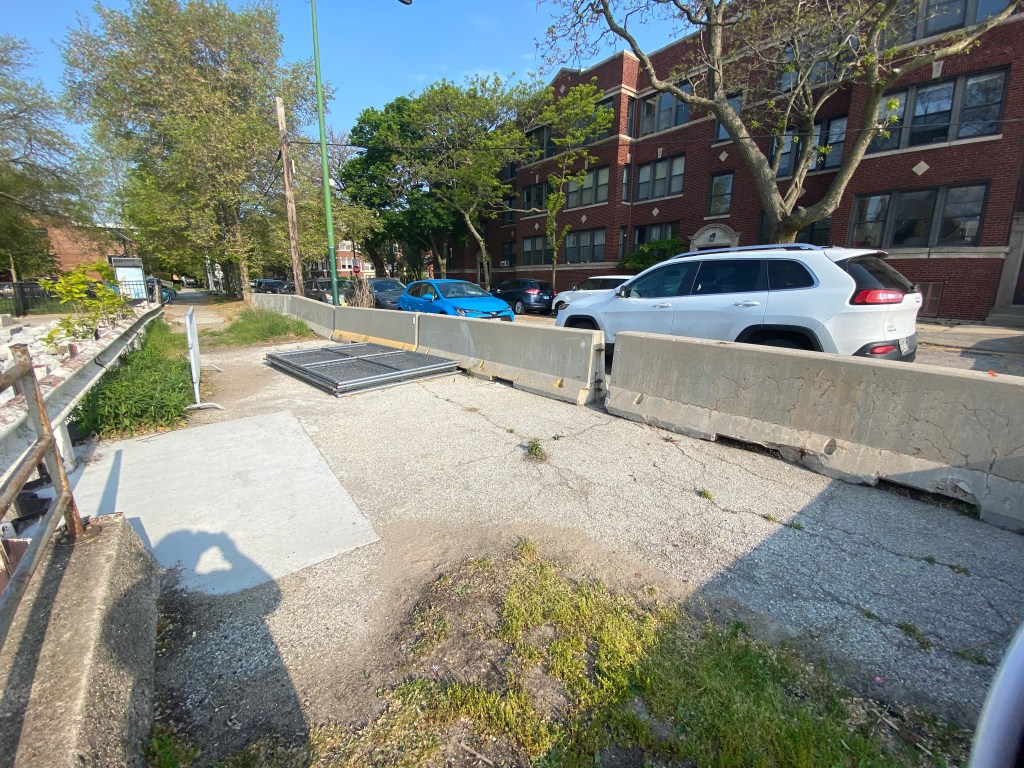
An easier fix is an underutilized existing space. North of Howard Beach Park, a blocked-off area could provide half a dozen additional parking spaces. I’m not sure if it is closed off because of structural concerns during the intense winter storms that caused the beach erosion or not but if the closure is not due to instability, rehabilitating that space seems like a smaller project compared to removing trees.
Parking Behavior
Frankly, the people in Rogers Park aren’t great at parking. It’s honestly the reason I got rid of my car. I was forced to park farther and farther from my apartment which at that time was at Northshore and Clark or on Ravenswood which resulted in a small fortune in parking tickets. I often wished that people had to park in neutral so that their cars could be pushed the 4-6 inches it would take to have a functional spot behind them. I believe it is essential to influence parking behavior and I think that implementing painted parking lines could maximize space utilization and educate people on how closely they should park to one another.
Environmental Impact
I’ve saved what I consider to be the most important for last. I understand that no matter what, structural changes to the street may be needed. If work must be done, it should be conducted with the site’s ecosystem in mind and equal resources committed to the preservation and rehabilitation of the area. Costly requirements like permeable pavement, rainwater management, and other green infrastructure solutions must be seriously considered.
Howard Beach Park is already a fragile recovering habitat. As you may have seen in neighborhood Facebook groups, residents have been excitedly sharing sightings of a hawk. The trees along Eastlake Terrace serve as perches for the hawk during its hunting activities. Although the trees slated for removal might not be large enough to house the hawk, their elimination would still impact its hunting and possibly breeding. If the hawk is indeed a Cooper’s Hawk, as many suspect, it is worth noting that they have only recently been removed from the State of Illinois Endangered Species list.
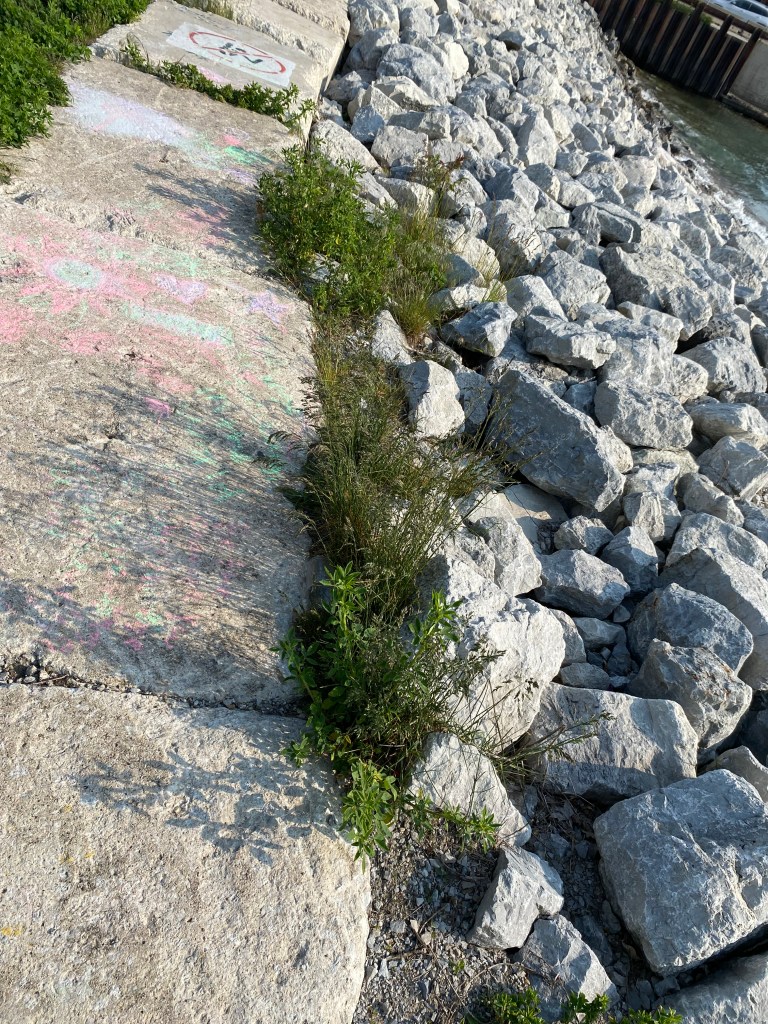
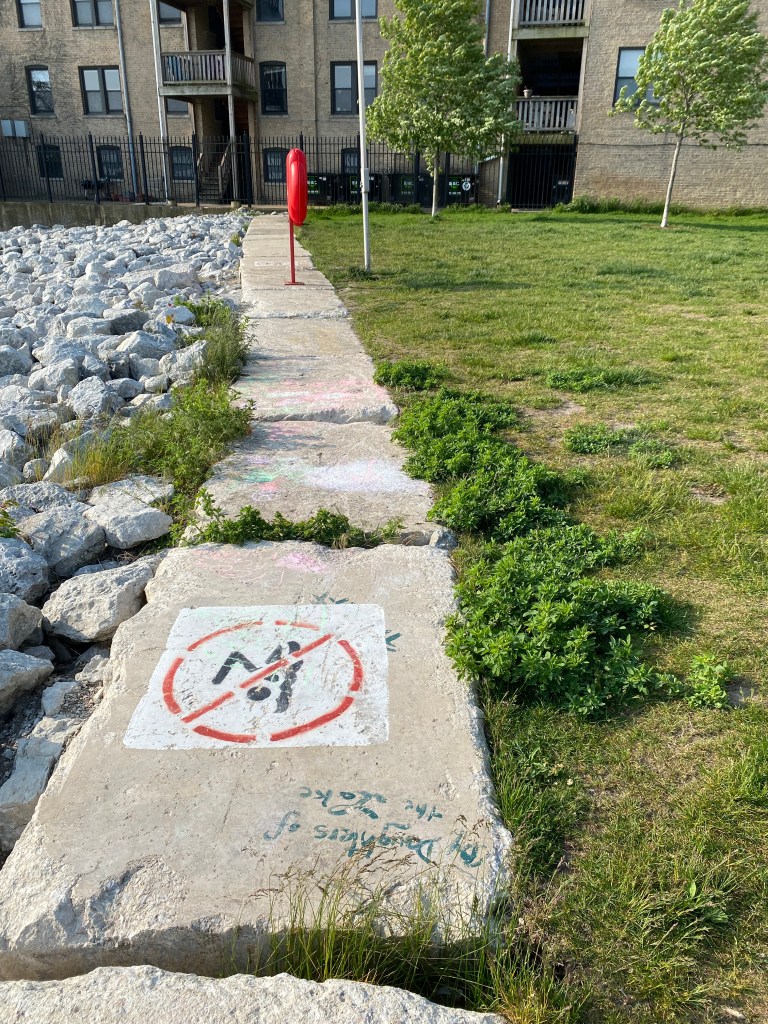
Changing the layout of the street will change the footprint and use of the park. The park has already gone through major land changes in recent years. While the project to prevent erosion during the winter storms was necessary, no further action has been taken. The blocks installed stopped the erosion but are not a long-term solution. The problem hasn’t gone away, just been stalled. As time goes on, the blocks are breaking down, creating unique soil conditions in which non-native plants are taking root and may further destroy the park. A restoration plan, similar to what has been done at Loyola Beach, needs to be created and considered as part of the cost for the overall parking proposal. I believe that adding a curved line of rocks to the north of the beach, and extending the existing retaining wall, can break up the power of the waves hitting the beach, further reducing eroding. That would also allow for the rocks to be removed from the steps down to the beach as they would be protected, meaning that people could access it again.
In conclusion, I believe it is crucial to explore alternative common sense solutions and exhaust existing resources before resorting to tree removal. By implementing the suggestions mentioned above and studying their effectiveness, we can address the parking issues while preserving the neighborhood’s fragile ecosystem.
Thank you for your attention to these concerns. I hope you will consider the points I have raised and work towards a solution that benefits both the community and the environment.
P.S. While I have your attention, can we change the light over the playground to be motion activated? The tall bright light is messing with the area’s nocturnal animals. I understand its need as a deterrent for criminal/risky behavior but I think switching it to motion activated could accomplish the same thing. Thanks.



 Birchwood Butterfly Corner